Monday, November 7, 2011

Reflection Post #1

I've chosen to compare my site with Megan Morvey's site in Springfield, MO.

First a look at overall temps and rainfall amounts.

Found here: http://www.world-climates.com/city-climate-limon-costa-rica-north-america/  
Found here: http://www.world-climates.com/city-climate-springfield-missouri-usa-north-america/
There is a dramatic temperature changes in Springfield as compared to Limon, which will never see a 30 degree temp, but in Springfield it's common in winter months. Limon pays for it's milder weather with higher rainfall amounts, seeing 2 to 3 times more rainfall than Springfield on average. Also notice that when Springfield is getting it's heaviest rainfall, Limon is receiving some it's lightest, and vice versa.

This difference in temperature and rainfall have a few causes. 

The first is latitude, which is a difference of almost 30 degrees (Limon = 9° N / Springfield = 37°N).

The second cause is the Continental Polar air mass that swings south in the winter months. 

Map of North America showing the Cold Continental Polar Air Mass (cP) moving southward to meet with the Maritime Tropical Air Mass (mT) moving north from the Gulf Of Mexico. The cP brings cold arctic air with it, which causes dramatic shifts in temperatures for Springfield, MO, and the mT brings warm, moisture laden air that feeds thunderstorms and snowfall. The collision of these two air masses is responsible for the severe weather in Springfield. When warm air moves into a region of colder air, the warm air is forced to rise. As warm air reaches the dew point clouds form and moisture falls. If the air below is cold enough, it creates the snow and ice storms that are so common in the Springfield winter. When these air masses collide in spring the rising warmer air forms clouds that are put into a cyclonic motion by upper level winds, creating super cells that form tornadoes.

Limon is not directly affected by these air masses because it is so far south. Limon sees neither this kind of severe weather nor drastic temperature changes.
Found here: http://frank.mtsu.edu/~cdharris/GEOL100/weather/wthr-sum11.htm


During the year Springfield has a variety of severe weather. This is mostly caused from the meeting of the cP and the mT.


January ice storm in Springfield, MO. Found here: http://activerain.com/blogsview/35687/springfield-missouri-ice-storm-2007-part-2


Tornado near Aurora, MO, May 2003. Found here: http://www.crh.noaa.gov/sgf/?n=photos_tornadoes

Snow storm of October 2011 Springfield, MO. Found here: http://activerain.com/blogsview/2112757/2011-blizzard-in-springfield-missouri-we-finally-have-snow-

Meanwhile, in Limon, Costa Rica....
Beach near Limon, Costa Rica. Found here: http://www.arenal.net/costa-rica/costa-rica-destinations.htm
Limon sees nowhere near the sever weather Springfield does, but it does see greater amounts of rain.The rainy season runs November-January which is when the cP is moving southward. This movement cause the mT to move south as well, pushing excess moisture across the gulf toward Limon. It can sometimes rain for days on end, and Limon can see 15" of rain in December easily. 

Something Limon must deal with that Springfield does not is the movement of the ITCZ. 
The ITCZ moves north in summer months as the polar air mass in the North Pole shrinks. The ITCZ is an area of low pressure formed by the meeting of the trade winds. A low pressure system pulls air into the atmosphere where there air condenses. The rainy month of July in Limon is directly caused by the movement of the ITCZ. Springfield doesn't see this type of rain. In fact, when Limon is getting its heavy July rain, Springfield is seeing a lull in the heaviest rainfall. Found here: Found at http://www.newmediastudio.org/DataDiscovery/Hurr_ED_Center/Stages_of_Hurricane_Dev/ITCZ/ITCZ.html


The ITCZ doesn't get anywhere near the Continental U.S., let alone Springfield. When Limon is being saturated by ITCZ induced rainfall, Springfield is experiencing warm days with minimum rainfall.

It almost seems like Springfield can have more drastic changes in temperature and weather patterns in one month than Limon sees in a year!

Monday, October 31, 2011

Blog Post #2: Air Currents and Jet Streams

As mentioned in Post #1, Limon receives rain year round. Even in the 'dry' months the area receives over 5" of rain on average.
Rainfall amounts with temperature. Found here: http://www.world-climates.com/city-climate-limon-costa-rica-north-america/ 
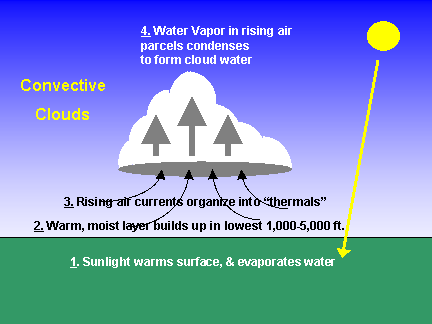
Rainfall amounts in Limon have mostly to due with convection.

Diagram showing how convection causes clouds and rainstorms.                                                                                          Found here: http://www.weatherquestions.com/How_do_clouds_form.htm
Costa Rica is surrounded by water on two sides. Since the air over land warms faster than the air over water, the air over Limon rises. The dew point in Limon is relatively high, usually staying within 10 degrees of the temperature, so the rising parcel quickly forms clouds and rain showers. 

Limon sits at 9 degrees north latitude, so it is only indirectly effected by the changes brought during winter in the northern hemisphere. 
Digital image showing the major air masses. This was taken in Spring or Fall. When it is winter in the northern hemisphere, the polar air mass moves farther south, pushing the warmer air masses south as well.                                                        Found here: http://www.weatherquestions.com/What_is_an_air_mass.htm
Winter in the northern hemisphere brings the rainy season. November through January see a rise in average rainfall. This is because the continental polar air mass shifts southward causing the maritime tropical air mass to also shift south. As it does, warm moist air moves across the gulf bringing heavier rains during these months.

The rest of the year is drier except for the huge spike in July. This spike has a lot to do with the movement of the International Convergence Zone (ITCZ)

ITCZ Movement Year Round. The ITCZ is a low pressure zone that promotes heavy rainfall across different areas as it moves north and south of the equator.                                                                                                                                   
(Found at http://www.newmediastudio.org/DataDiscovery/Hurr_ED_Center/Stages_of_Hurricane_Dev/ITCZ/ITCZ.html
As the ITCZ moves north it moves directly over Costa Rica in July, bringing heavy rainfall with it, thus there is a spike in the normal drier months, especially July.


Monday, October 17, 2011

Blog # 1: Average Temperature and Climate

A beach at Limon, Costa Rica, found here
This blog will follow the weather patterns of Puerto Limon, Costa Rica using the weather station at the airport in Limon. The airport sits along the coast about 2 miles south of the city so it should give a reasonably accurate account of weather in Limon.
(Found here)
 Limon is the major port city on the Caribbean side and has a rich history of export agriculture. Since Columbus landed in Limon in 1502, the area has exported cocoa, coffee, bananas and other tropical exports that have driven the local economy for over three hundred years. This agriculture exporting would not be possible without the perfect growing climate. Situated at just below 10° Latitude, Limon sees a year round warm and humid climate, considered a tropical climate similar to other well know Caribbean locations like Jamaica or Puerto Rico. The area very rarely rarely sees temperatures outside of  20° to 30° C (68° - 85° F), as you can see: 
(Courtesy of Weather-and-climate.com, found here)
There is rainfall year round. Hurricanes and tropical depressions are not common, but it can rain for several days straight during storms called temporales del Atlantico. These storms form from September though February as cold polar air pushes warm moisture laden air eastward across the gulf. As the graph below shows, there really is no dry season, as all months see moisture, but the rainy season runs from April / May through November / December with a lull in September. 

Courtesy of World-climates.com, found here.